

GVAX
Ganges Valley Aerosol Experiment (GVAX)
13 June 2011 - 31 March 2012
Lead Scientist: V. Rao Kotamarthi
Observatory: amf, pgh
The Ganges valley region is one of the largest and most rapidly developing sections of the Indian subcontinent. The Ganges River, which provides the region with water needed for sustaining life, is fed primarily by snow and rainfall associated with Indian summer monsoons. Impacts of changes in precipitation patterns, temperature, and the flow of the snow-fed rivers could be immense. Recent satellite-based measurements have indicated that the upper Ganges valley has some of the highest persistently observed aerosol optical depth values. The aerosol layer covers a vast region, extending across the Indo-Gangetic Plain to the Bay of Bengal during the winter and early spring of each year. The persistent winter fog in the region is already a cause of much concern, and several studies have been proposed to understand the economic, scientific, and societal dimensions of this problem. During the INDian Ocean EXperiment (INDOEX) field studies, aerosols from this region were shown to affect cloud formation and monsoon activity over the Indian Ocean. This is one of the few regions showing a trend toward increasing surface dimming and enhanced mid-tropospheric warming. Increasing air pollution over this region could modify the radiative balance through direct, indirect, and semi-indirect effects associated with aerosols. The consequences of aerosols and associated pollution for surface insolation over the Ganges valley and monsoons in particular are not well understood.
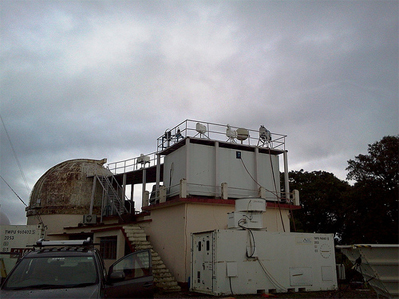
The proposed field study was designed for use of 1) the ARM Mobile Facility to measure relevant radiative, cloud, convection, and aerosol optical characteristics over mainland India during an extended period of 12 months; and 2) the G-1 aircraft* and surface sites to measure relevant aerosol chemical, physical, and optical characteristics in the Ganges valley during a period of 8-12 weeks. The aerosols in this region have complex sources, including burning of coal, biomass, and biofuels; automobile emissions; and dust. The extended AMF deployment enabled measurements under different regimes of the climate and aerosol abundance — in the wet monsoon period with low aerosol loading; in the dry, hot summer with aerosols dispersed throughout the atmospheric column; and in the cool, dry winter with aerosols mostly confined to the boundary later and mid troposphere. Each regime, in addition, has its own distinct radiative and atmospheric dynamic drivers. The aircraft operational phase assisted in characterizing the aerosols at times when they have been observed to be at the highest concentrations.
A number of agencies in India collaborated with the proposed field study and provided support in terms of planning, aircraft measurements, and surface sites. The high concentration of aerosols in the upper Ganges valley, together with hypotheses involving several possible mechanisms with direct impacts to the hydrologic cycle of the region, gave researchers a unique opportunity to generate data sets that will be useful both in understanding the processes at work and providing answers regarding the effects of aerosols on climate in a region where the perturbation is the highest.
*As of April 1, 2011, the G-1 no longer participated in this field campaign.
Co-Investigators
| Richard Coulter |
| Greg McFarquhar |
| Sethu Raman |
Timeline
Related Publications
2024
Singh J, N Singh, N Ojha, A Dimri, and R Singh. 2024. "Impacts of different boundary layer parameterization schemes on simulation of meteorology over Himalaya." Atmospheric Research, 298, 107154, 10.1016/j.atmosres.2023.107154.
Block K, M Haghighatnasab, D Partridge, P Stier, and J Quaas. 2024. "Cloud condensation nuclei concentrations derived from the CAMS reanalysis." Earth System Science Data, 16(1), 10.5194/essd-16-443-2024.
2023
Rajput A, N Singh, J Singh, and S Rastogi. 2023. "Insights of Boundary Layer Turbulence Over the Complex Terrain of Central Himalaya from GVAX Field Campaign." Asia-Pacific Journal of Atmospheric Sciences, , 10.1007/s13143-023-00341-5.
2022
Rajput A, N Singh, J Singh, and S Rastogi. 2022. "Investigation of atmospheric turbulence and scale lengths using radiosonde measurements of GVAX-campaign over central Himalayan region." Journal of Atmospheric and Solar-Terrestrial Physics, 235, 105895, 10.1016/j.jastp.2022.105895.
2021
Dumka U, P Kosmopoulos, S Ningombam, and A Masoom. 2021. "Impact of Aerosol and Cloud on the Solar Energy Potential over the Central Gangetic Himalayan Region." Remote Sensing, 13(16), 10.3390/rs13163248.
Singh J, N Singh, N Ojha, A Sharma, A Pozzer, N Kiran Kumar, K Rajeev, S Gunthe, and V Kotamarthi. 2021. "Effects of spatial resolution on WRF v3.8.1 simulated meteorology over the central Himalaya." Geoscientific Model Development, 14(3), 10.5194/gmd-14-1427-2021.
Riihimaki L, C Flynn, A McComiskey, D Lubin, Y Blanchard, J Chiu, G Feingold, D Feldman, J Gristey, C Herrera, G Hodges, E Kassianov, S LeBlanc, A Marshak, J Michalsky, P Pilewskie, S Schmidt, R Scott, Y Shea, K Thome, R Wagener, and B Wielicki. 2021. "The Shortwave Spectral Radiometer for Atmospheric Science: Capabilities and Applications from the ARM User Facility." Bulletin of the American Meteorological Society, 102(3), 10.1175/BAMS-D-19-0227.1.
Manoj M, S Lee, and Z Li. 2021. "Competing aerosol effects in triggering deep convection over the Indian Region." Climate Dynamics, 56(5-6), 10.1007/s00382-020-05561-3.
Research Highlight
2020
Dumka U, D Kaskaoutis, N Mihalopoulos, and R Sheoran. 2020. "Identification of key aerosol types and mixing states in the central Indian Himalayas during the GVAX campaign: the role of particle size in aerosol classification." Science of The Total Environment, 761, 143188, 10.1016/j.scitotenv.2020.143188.
Burgos M, E Andrews, G Titos, A Benedetti, H Bian, V Buchard, G Curci, Z Kipling, A Kirkevåg, H Kokkola, A Laakso, J Letertre-Danczak, M Lund, H Matsui, G Myhre, C Randles, M Schulz, T van Noije, K Zhang, L Alados-Arboledas, U Baltensperger, A Jefferson, J Sherman, J Sun, E Weingartner, and P Zieger. 2020. "A global model–measurement evaluation of particle light scattering coefficients at elevated relative humidity." Atmospheric Chemistry and Physics, 20(17), 10.5194/acp-20-10231-2020.
View All Related Publications
PGH Data Sources
| Name | Full Name | Browse Data |
|---|---|---|
AERI |
Atmospheric Emitted Radiance Interferometer | Browse Data |
AERINF |
AERI Noise Filtered | Browse Data |
AIP |
Aerosol Intensive Properties | Browse Data |
AOD-MFRSR |
Aerosol Optical Depth (AOD) derived from MFRSR measurements | Browse Data |
AOS |
Aerosol Observing System | Browse Data |
AOSCCNAVG |
Aerosol Observing System (AOS): cloud condensation nuclei data, averaged | Browse Data |
CCN |
Cloud Condensation Nuclei Particle Counter | Browse Data |
CEIL |
Ceilometer | Browse Data |
CLAP |
Continuous Light Absorption Photometer | Browse Data |
CPC |
Condensation Particle Counter | Browse Data |
CSPHOT |
Sunphotometer | Browse Data |
DL |
Doppler Lidar | Browse Data |
DLPROF-WIND |
Doppler Lidar Horizontal Wind Profiles | Browse Data |
DLPROF-WSTATS |
Doppler Lidar Wind Statistics Profiles | Browse Data |
ECMWFDIAG |
European Centre for Medium Range Weather Forecasts Diagnostic Analyses | Browse Data |
GNDRAD |
Ground Radiometers on Stand for Upwelling Radiation | Browse Data |
MET |
Surface Meteorological Instrumentation | Browse Data |
MFRSR |
Multifilter Rotating Shadowband Radiometer | Browse Data |
MFRSRCLDOD |
Cloud Optical Properties from MFRSR Using Min Algorithm | Browse Data |
MPL |
Micropulse Lidar | Browse Data |
MWR |
Microwave Radiometer | Browse Data |
MWRHF |
Microwave Radiometer - High Frequency | Browse Data |
MWRP |
Microwave Radiometer Profiler | Browse Data |
MWRRET |
MWR Retrievals | Browse Data |
NEPHELOMETER |
Nephelometer | Browse Data |
NFOV |
Narrow Field of View Zenith Radiometer | Browse Data |
PBLHT |
Planetary Boundary Layer Height | Browse Data |
PSAP |
Particle Soot Absorption Photometer | Browse Data |
QCRAD |
Data Quality Assessment for ARM Radiation Data | Browse Data |
RWP |
Radar Wind Profiler | Browse Data |
SASHE |
Shortwave Array Spectroradiometer-Hemispheric | Browse Data |
SASZE |
Shortwave Array Spectroradiometer-Zenith | Browse Data |
SKYRAD |
Sky Radiometers on Stand for Downwelling Radiation | Browse Data |
SONDE |
Balloon-Borne Sounding System | Browse Data |
SONDEADJUST |
Sonde Adjust | Browse Data |
TSI |
Total Sky Imager | Browse Data |